
First, the disambiguation: this is Wellington, New South Wales, the valley town in the Dubbo region, not the windy capital across the Tasman. Second, the pitch: a weekend here gets you a river junction that stopped an explorer in his tracks in 1816, a Japanese garden at a caves complex, and a lake that once swallowed a town whole.
It’s a different kind of weekend to the coastal run. Slower, stranger, far better value, and with none of the beach-town queueing for coffee. Logistics are simple: arrive Friday evening, give Saturday to the town and Sunday to the water, and note that nothing here needs booking weeks out, which is half the point of the central west. Here’s how a local would shape it.
The shape of the two days
- Saturday: the Oxley Museum first for the backstory, then Cameron Park, a long lunch at Cactus Cafe & Gallery, and the Japanese gardens in the afternoon light.
- Sunday: Lake Burrendong with a rod, a boat or just a picnic blanket, and stay out there until it’s time to point the car home.
Start with the river that started everything
Wellington’s origin story is on display at the Oxley Museum, on the corner of Percy and Warne Streets. John Oxley, surveyor and explorer, came through in 1816 after slogging across what the record politely calls very disappointing country. Then the Wellington Valley opened up, and Oxley followed a stream along its bank until his path was stopped by what he described as “a very fine river”.
Two centuries later, that assessment holds. The museum is the right first stop because it hands you the story you’ll keep tripping over for the rest of the weekend: the valley, the river, and the town that grew where Oxley stopped being disappointed. Country museums run on volunteer hours, so check the opening times before you build a morning around it.
Saturday in town: memorials, roses and milkshakes
Cameron Park sits in the heart of Wellington, just off the Mitchell Highway, and turned 100 in 2010. It packs a lot of history into its gardens: a granite Cenotaph honouring the fallen, a 25-pounder Gun-Howitzer, and a Lone Pine tree grown from a seed brought back from Gallipoli, alongside a cascading fountain, a sunken rose garden and a modern playground for the kids. The bridge connecting Pioneer Park to the CBD gives you the best view of it, a leisurely walk through the town centre gets you there, and spring and summer are when the gardens earn their keep. It’s run by Dubbo Regional Council, and it shows in the upkeep.
Lunch belongs to Cactus Cafe & Gallery, housed in the former Sacred Heart Infants’ School built in the early 1900s. The menu keeps it honest, with melts, nachos and fish and chips done properly, and the milkshakes have a reputation of their own around town. The gallery side sells handmade jewellery and pottery, and the staff hand out local knowledge for free, which is worth more than the coffee.
The garden you don’t expect out here
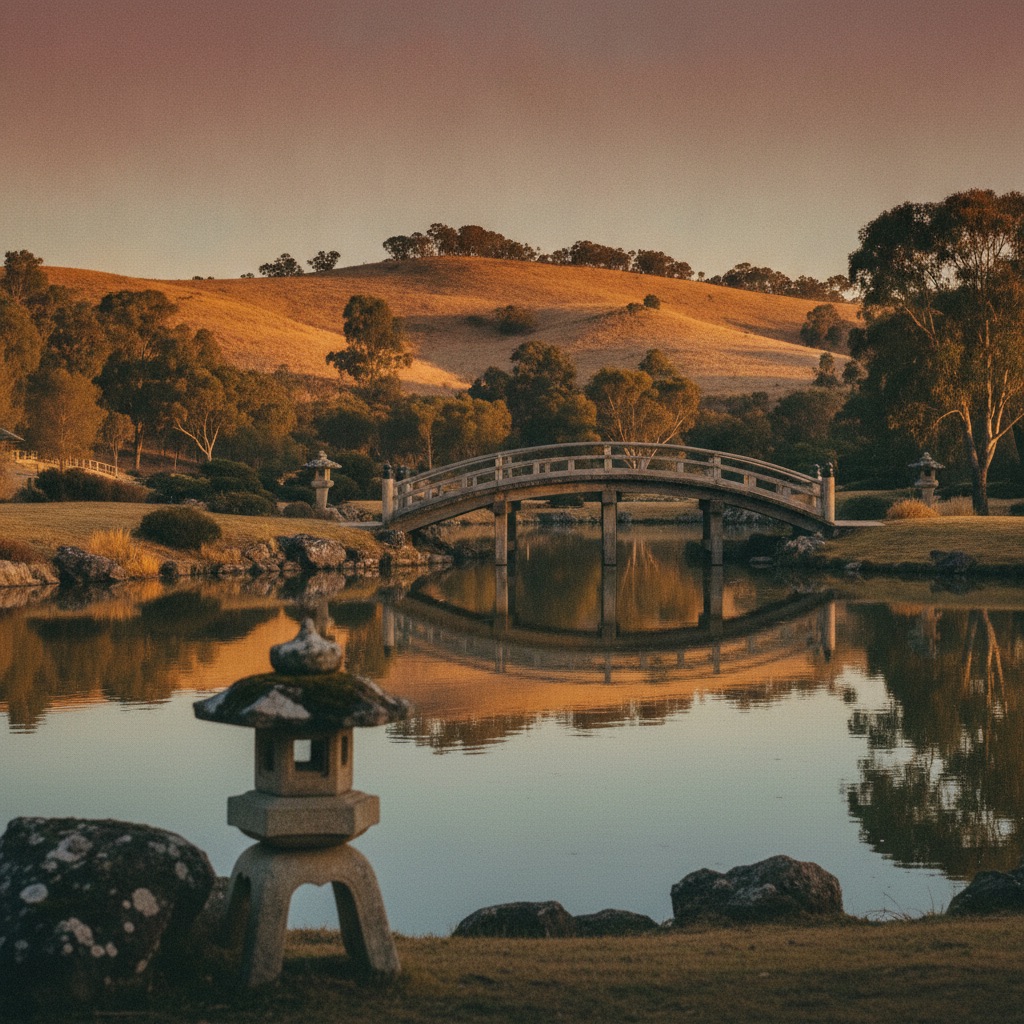
Eight kilometres southeast of town along the Mitchell Highway, at the Wellington Caves Complex, the Wellington Osawano Japanese Gardens are the weekend’s curveball. Built between February and November 1999 with funding from Japan’s Osawano Town Council and a design by Wellington Council, they run the full traditional repertoire: water, stone, lanterns, bridges and carp, plus a man-made mountain, a cascading stream and a reflection lake.
The numbers are serious for a country-town garden: 1,500 individual plants across 126 species, mixing exotic and Australian stock, arranged to give cherry blossoms in spring, colour in autumn and shade in summer. The gardens are open throughout the year, and locals book them for weddings and functions. Watch the water long enough and the carp will find you. Go in spring or autumn if you can choose, when the colours do their best work.
Sunday: the lake with a drowned town in it
Lake Burrendong is the big day out. Burrendong Dam, built between 1946 and 1967 to supply irrigation water to the Macquarie Valley, impounds the Macquarie and Cudgegong rivers and Meroo Creek, creating a lake of roughly 1,189,000 megalitres across 8,900 hectares, one of the largest inland waterways in New South Wales.
The fishing is the drawcard: golden perch, Murray cod and catfish all live in the lake, and the water carries boats, kayaks and water skiers with room to spare. The surrounding bushland does bushwalking and birdwatching for the land-based half of your party, so nobody is stuck minding the esky. Pack the day around it: this is not a place you drop into for an hour.
And the secret: during the 2019 drought the lake dried up and revealed the remains of a former town, submerged when the dam was built. The ruins have gone back under, but knowing they’re down there changes how the water looks. It’s the detail that turns a nice day at a lake into the story you tell at dinner for a month.
Where to stay
Hermitage Hill Country Retreat at 135 Maxwell Street is the characterful pick: a historic building of locally quarried bluestone on a hilltop, with valley views, sprawling lawns, an outdoor pool, a sun terrace and free parking. It photographs like somewhere three times the price, and the hilltop position means the valley views come free with breakfast.
Bridge Motel Wellington on Lee Street is the practical pick, and quietly generous with it: two outdoor swimming pools, river frontage, a barbecue area, a breakfast room, free Wi-Fi and pet-friendly rooms, so the dog gets to do the weekend too.
Make a proper trip of it
Wellington rewards the unhurried. When you’ve done this list, keep going with the full list of things to do in Wellington, check the Wellington food & drink listings for the next meal, and browse the Wellington local guide for everything in between. Two days, no queues at all, and one very fine river.